Letting daily drivers fill up to three seats in one app instead of juggling BlaBlaCar and BlaBlaLines in parallel.
Three quarters of commute drivers passed multiple passengers on their route, yet the app locked every trip to a single booking—forcing power users onto both BlaBlaCar and BlaBlaLines and stranding unmatched commuters. I mapped and designed the end-to-end multi-passenger architecture across onboarding, home, ride settings, and incoming requests.
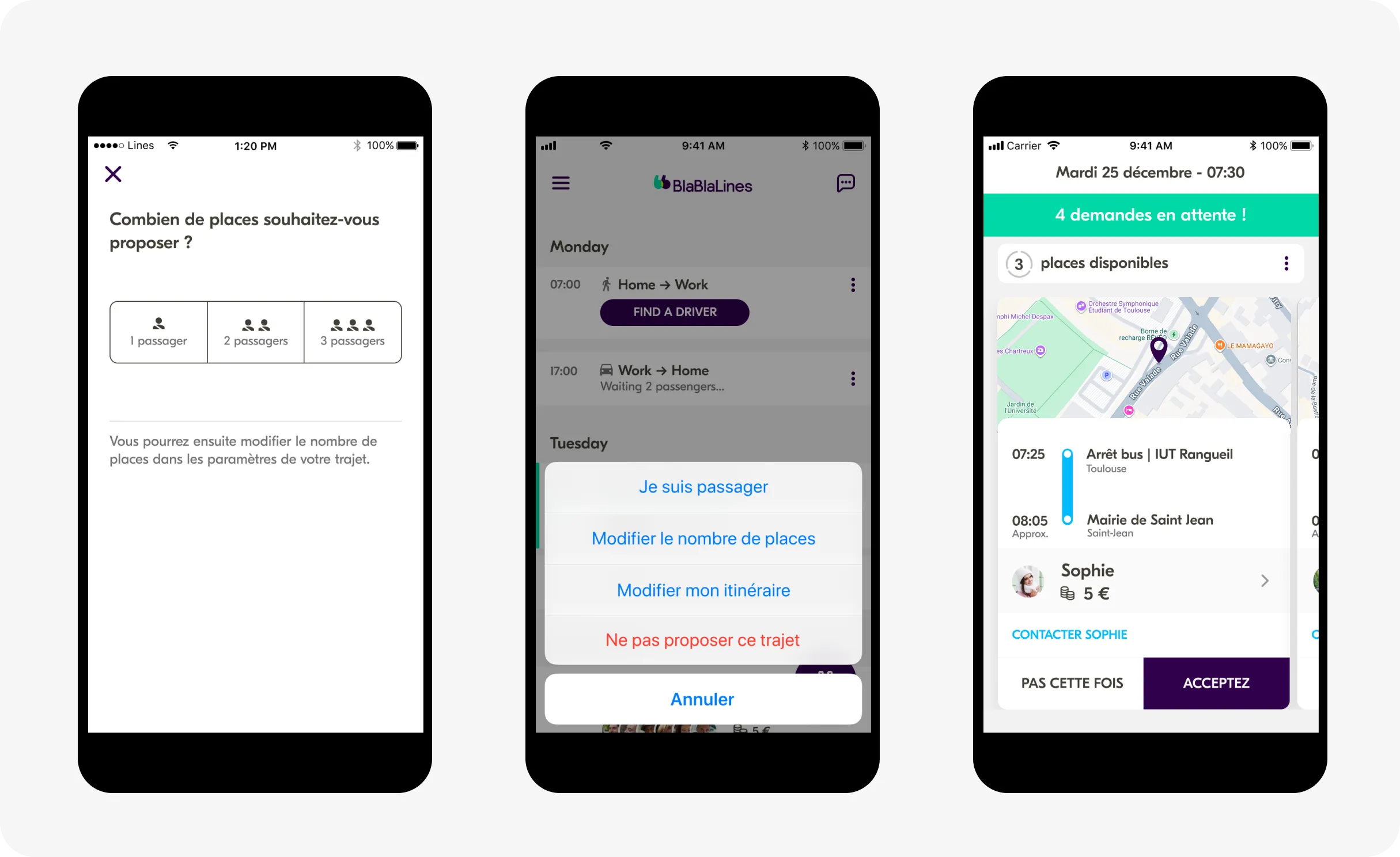
Three quarters of drivers passed multiple commuters, yet a 1-seat ceiling forced a painful two-app workaround
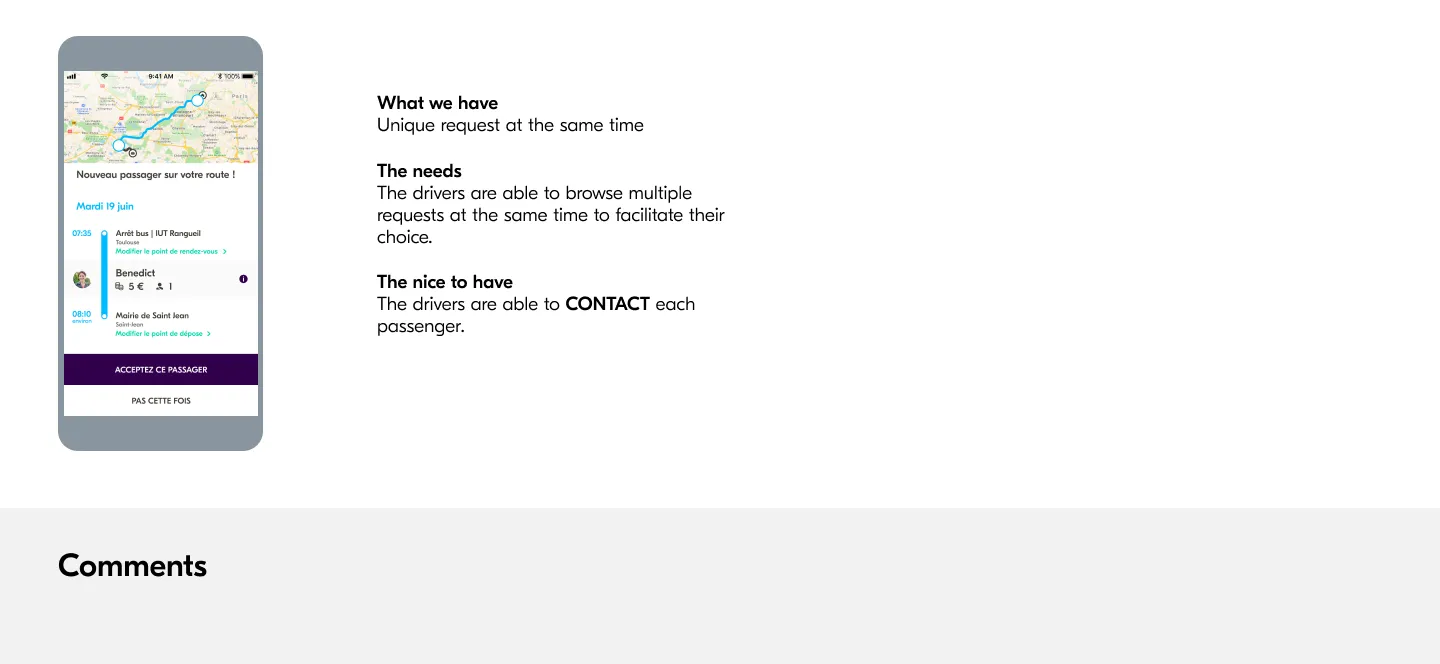
On BlaBlaLines (now BlaBlaCar Daily), the entire matching loop assumed one driver carried a single commuter. Onboarding went straight from role selection ("J’ai un véhicule") to route publication without ever asking seat capacity, and incoming booking screens could only display one passenger request at a time.
Because 75% of drivers had multiple commuters along their corridor, power users resorted to publishing their daily drive on both BlaBlaCar and BlaBlaLines simultaneously. Drivers endured double notifications and manual seat math, while passengers hit empty search results whenever another commuter had already booked the sole slot on a car with two empty seats.
Vehicle & comfort constraint: Company two-seaters, Smart cars, and luggage days meant we could never silently assume 3 seats for every driver—capacity had to be explicit, capped at 3 passengers maximum, and adjustable per commute.
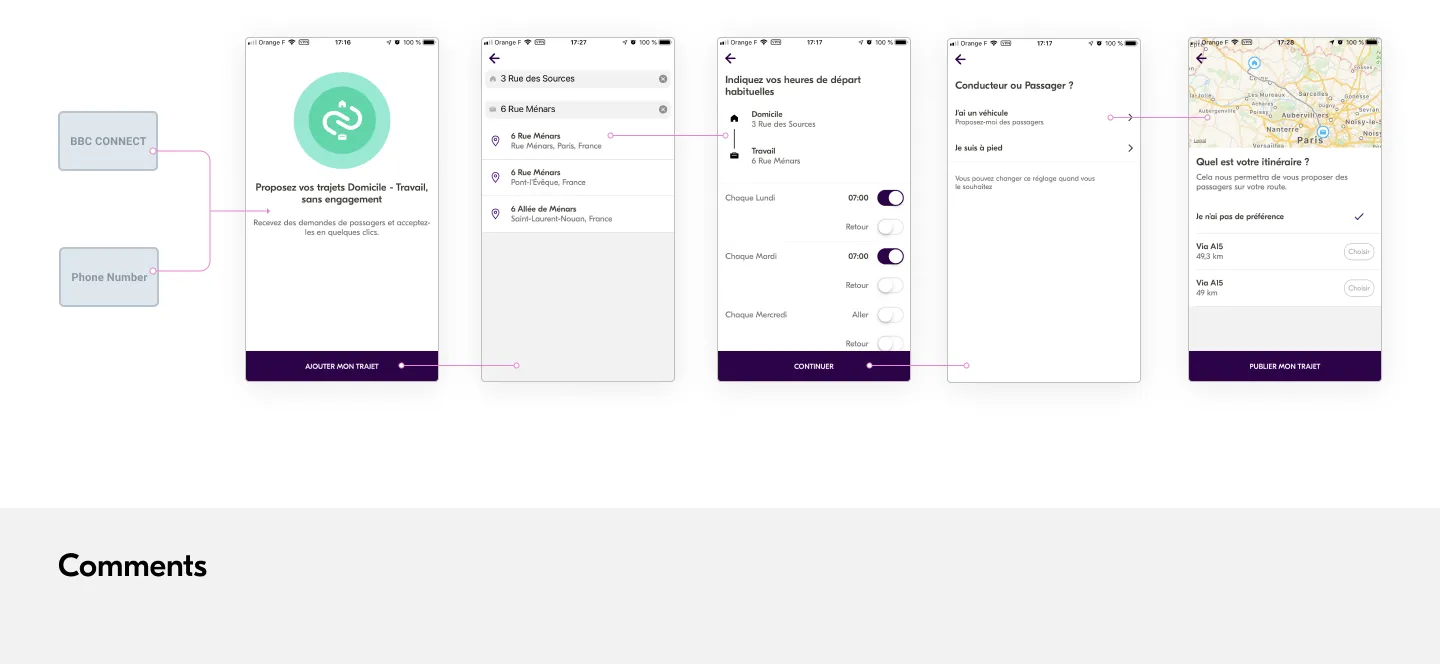
Capturing seat capacity right after role selection and tying every extra seat to concrete commute earnings
Before drawing screens, I mapped the impact across the entire mobile app—isolating Driver-only changes (Onboarding, Home, Settings, Requests) from shared Driver & Passenger surfaces (Ride Details)—so multi-seat support wouldn’t complicate passenger booking.
Rigid 1-passenger ceiling per commute forcing power users to cross-post rides on both BlaBlaCar and BlaBlaLines
Explicit 1–3 seat setup paired with per-ride earnings (3€ / 6€ / 9€), per-trip overrides, and a multi-request carousel
Inserted # SEATS immediately after Driver/Passenger selection (Proposal 1)
We evaluated two onboarding sequences: asking seat count right after "PSGR or DRVR" (Proposal 1) versus after "Itinerary" (Proposal 2). Grouping seat capacity immediately with vehicle ownership kept mental context intact before map and route selection.
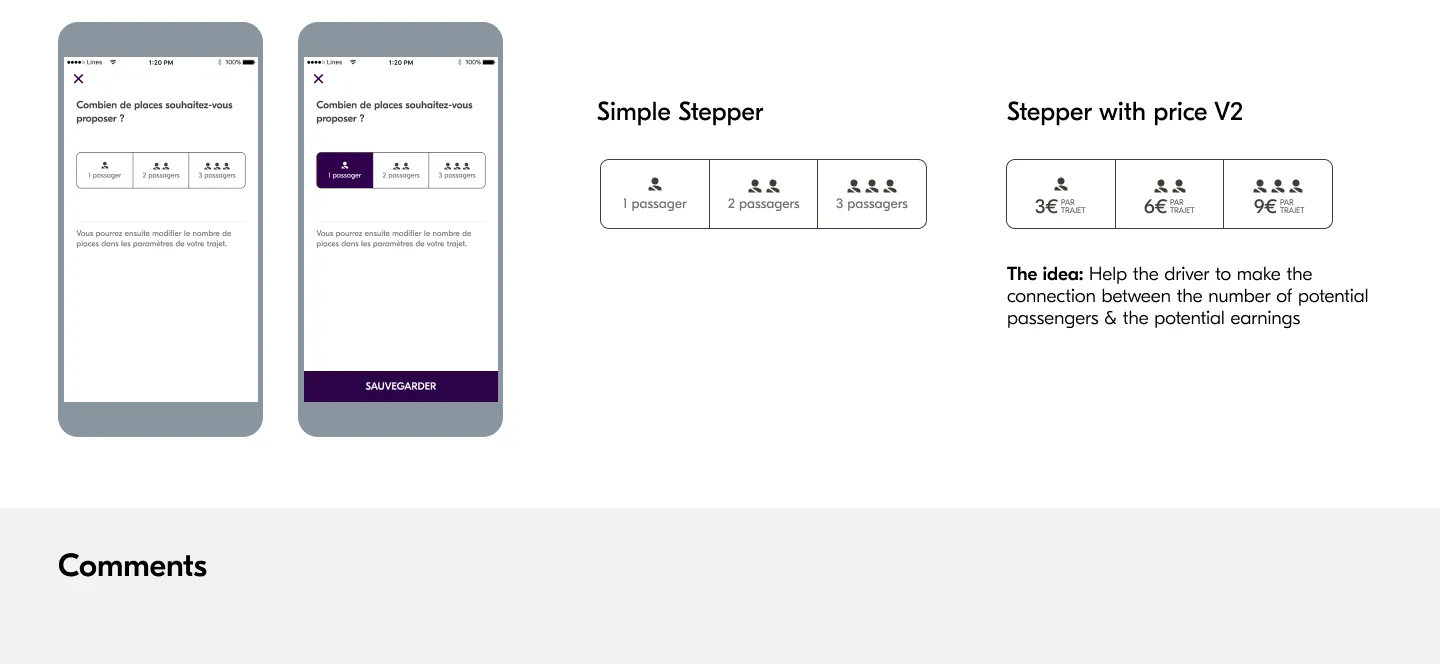
Evolved a plain seat counter (V1) into an earnings-linked stepper (V2)
Our V1 stepper only read "1 / 2 / 3 passagers", which framed extra passengers as extra coordination effort. V2 ("3€ / 6€ / 9€ par trajet") made the financial upside of filling seats self-evident while enforcing a hard 3-seat cap to keep the middle rear seat comfortable.
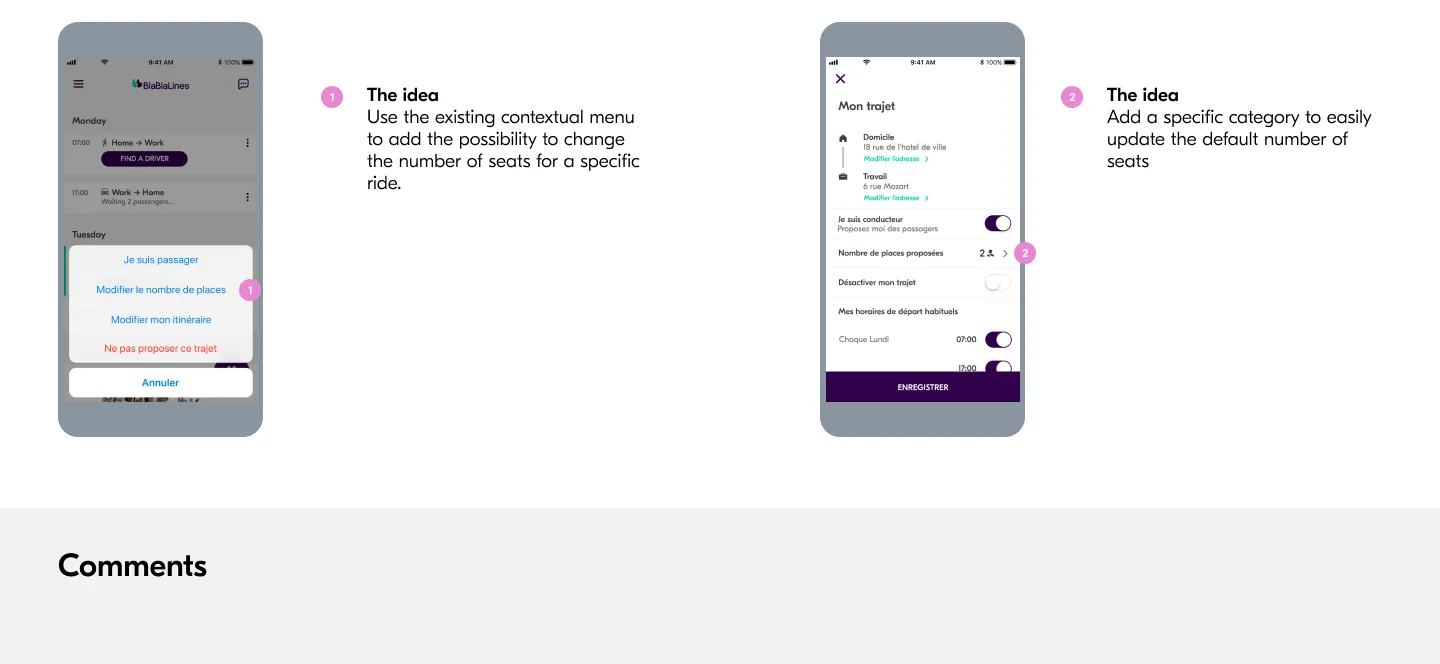
Split permanent default capacity from one-tap per-ride overrides
A driver who usually offers 2 seats might drive a 2-seat company car on Wednesday or carry luggage on Friday. Pairing a default setting in "Mon trajet" with an inline action in the existing Home contextual menu avoided burying daily adjustments inside profile settings.
A synchronized seat ledger across Onboarding, Home timeline, and the Multi-Request Carousel
Once seat capacity is captured, every downstream driver touchpoint reflects live fill-up progress and lets drivers evaluate multiple overlapping commuters side by side.
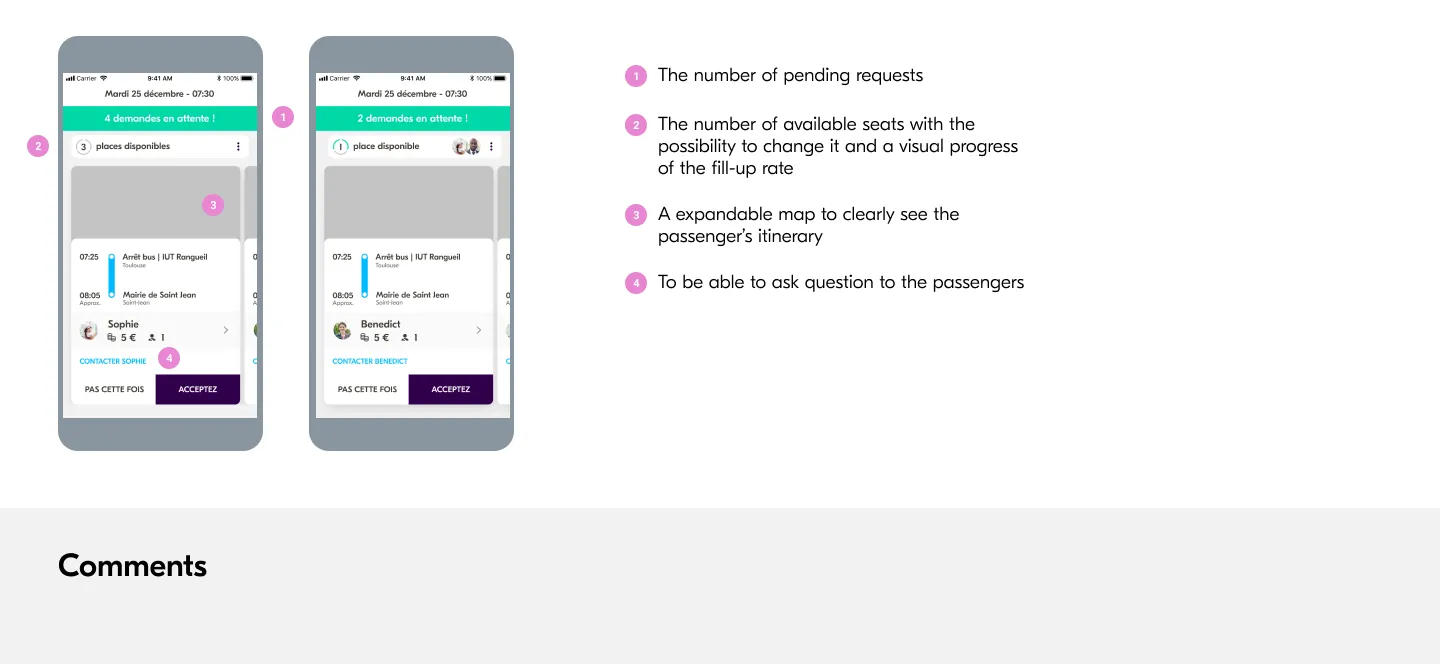
Simultaneous pending-requests banner
A high-contrast emerald bar ("4 demandes en attente !" → "2 demandes en attente !") makes concurrent demand immediately visible when opening a commute.
Circular fill-up gauge & booked passenger avatars
Below the banner, a live status pill tracks remaining seats ("3 places disponibles" → "1 place disponible"), displays accepted passengers’ avatars, and exposes a quick overflow menu to edit capacity.
Swipeable commuter cards with expandable route map
Drivers swipe horizontally across candidate cards showing pickup/drop-off stops (07:25 IUT Rangueil → 08:05 Mairie de Saint Jean), fare contribution (5 €), and an expandable map preview.
Pre-booking passenger messaging & Home contextual sheet
Each card embeds a direct "CONTACTER" action to clarify pickup logistics before tapping "ACCEPTEZ", while the Home timeline menu handles single-commute seat changes.
Architectural scope & product guardrails across five mobile surfaces
Designed within the Core Experience mobile team at BlaBlaCar Daily as a full-system UX architecture proposal—connecting driver onboarding, timeline controls, and multi-passenger request triage without inventing unverified post-departure telemetry.
Onboarding, Home timeline, Settings, Requests (Driver-only), and shared Ride Details.
V2 stepper links 1, 2, or 3 offered seats directly to daily driver cost-sharing.
Protects rear-seat comfort, limits cumulative detour time, and respects 2-seat vehicles.
Systemic guardrails & edge cases addressed
- Prevented accidental overbooking on enterprise two-seaters and Smart cars by asking seat count explicitly whenever a driver reaches out to multiple passengers.
- Isolated multi-seat complexity on the Driver side so commuters continue booking a single driver with zero extra cognitive load.
- Eliminated the structural incentive for power users to double-post daily commutes across both BlaBlaCar and BlaBlaLines.