Letting migrating businesses keep their exact legal numbering sequence through structured tokens rather than rigid prefixes.
Spotted via Hotjar session recordings and verified against real French SME documents, Shine’s hardcoded FACTURE- prefix and unpadded integer counter broke sequence continuity for switching businesses—right before the September 2026 e-invoicing reform.
Invoice numbering
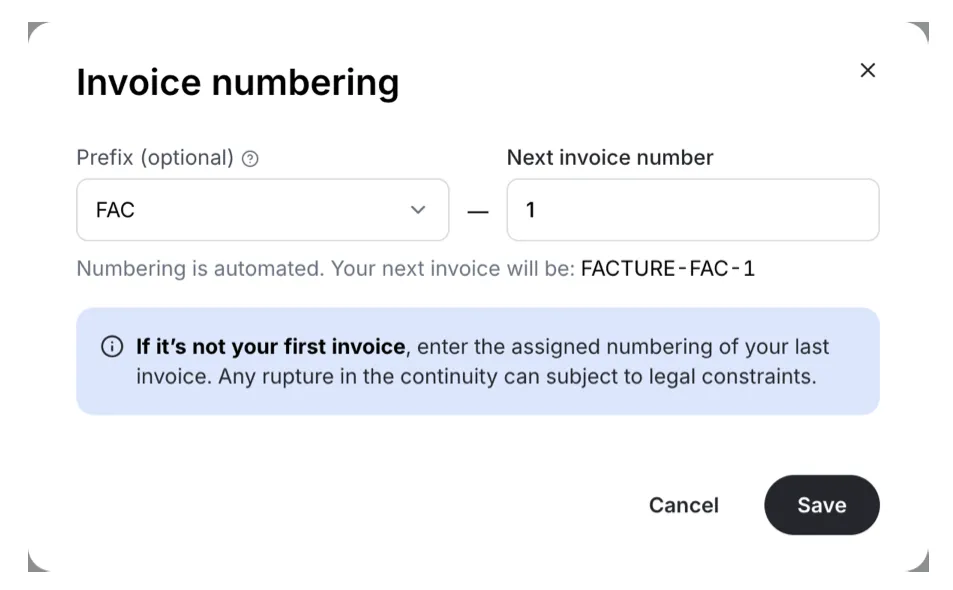
DEFAULT STATEInvoice numbering (Legacy production)
HARDCODED PREFIXNumbering is automated. Your next invoice will be: FACTURE-FAC-1
Hardcoded prefixes forced awkward compound numbers like FACTURE-FAC-1 and blocked legal migration
While reviewing Hotjar session recordings of invoicing setup, I noticed users repeatedly struggling with the numbering modal. Even after a recent fix that delayed number assignment until finalization, two structural blockers remained: users could only append a prefix after Shine’s hardcoded FACTURE- string, and the counter offered no zero-padding (0001).
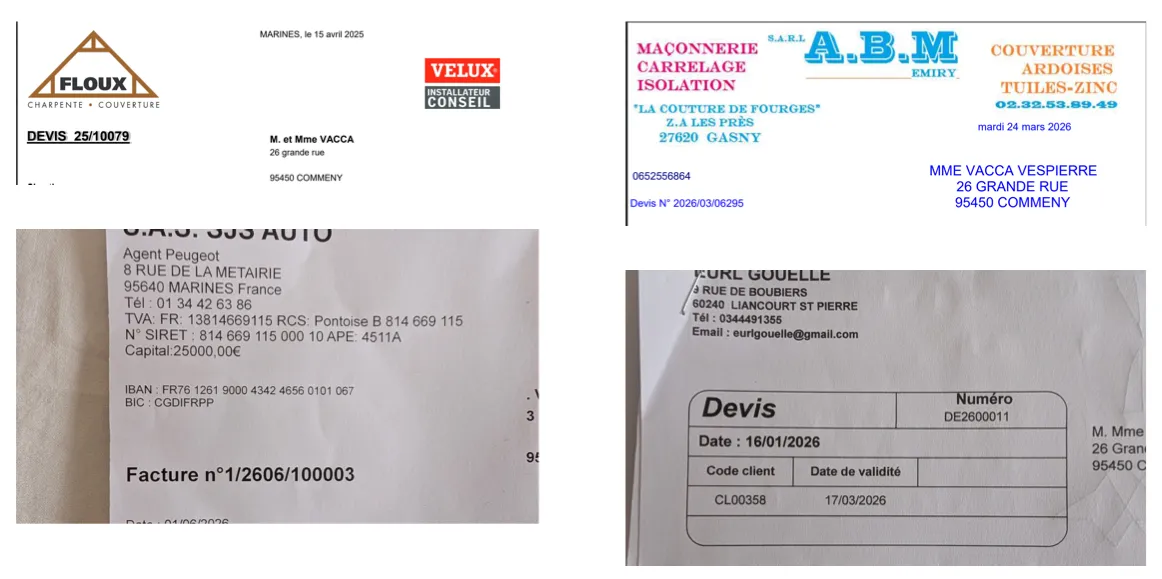
To check whether this was an edge case or a systemic market norm, I audited real invoices and quotes issued by French artisans and SMEs—a reality shared equally by the German market.
Regulatory catalyst: France’s mandatory electronic invoicing reform takes effect in September 2026. Accounting law requires strict, uninterrupted chronological numbering—a business whose last invoice elsewhere was 2026-06-0147 must start on Shine at 2026-06-0148, or risk compliance rejection and onboarding drop-off.
| Business | Document | Observed sequence | Underlying structure |
|---|---|---|---|
| SARL A.B.M | Quote | 2026/03/06295 | YYYY/MM/NNNNN |
| FLOUX Charpente | Quote / Invoice | 25/10079 · 24/04684 | YY/NNNNN |
| SJS Auto (Peugeot) | Invoice | 1/2606/100003 | N/YYMM/NNNNNN |
| EURL Gouelle | Quote | DE2600011 | PREFIX + YY + NNNNN |
Structured tokens prevent compliance mistakes that a raw free-text field would invite
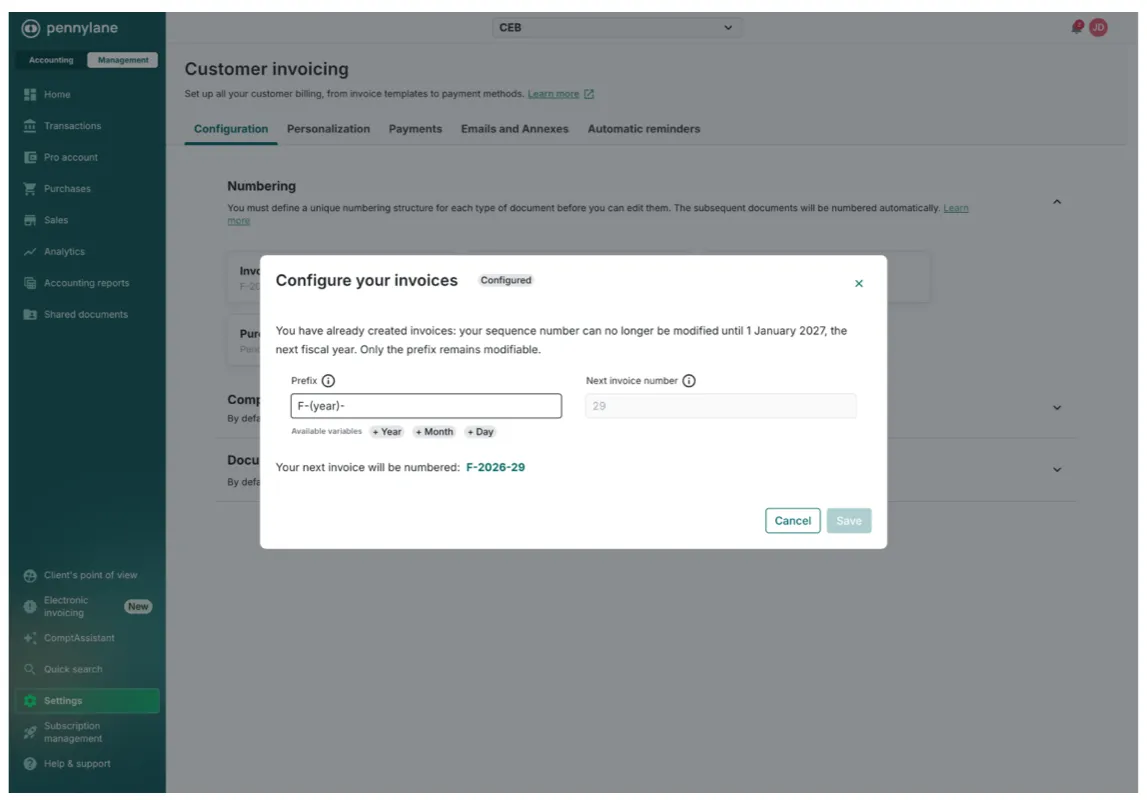
Benchmarking French accounting leaders Indy and Pennylane confirmed that dynamic date and padding variables are table stakes. The core design challenge was giving migrating users complete format freedom without letting them accidentally create static, non-incrementing numbers.
Non-replaceable FACTURE- prefix plus a bare integer input that breaks accounting import compatibility
Token-based numbering templates (YYYY, YY, MM, NNNN) paired with presets, live sequence preview, and custom starting number
Token grammar instead of unconstrained free text
Allowing arbitrary free text lets users hardcode "2026" as plain characters that fail to roll over in January, or omit the sequential counter altogether. Tokens (YYYY, YY, MM, N..NNNN) plus explicit separators (/, -, or none) guarantee valid chronological sequences.
Bridging friendly presets and custom prefix building in Figma
To resolve whether tokens would intimidate solo freelancers, the Figma exploration pairs ready-made convention presets (e.g. INV-YYYY-MM-001, FAC-YY-0001) in the empty-prefix dropdown with direct segment highlighting in the live preview card.
Strict backward compatibility for existing Shine accounts
Existing Shine users keep their active numbering sequence untouched unless they explicitly opt to reconfigure it, avoiding any surprise disruption mid-fiscal year.
Interactive segment highlighting so users verify their exact next legal number before saving
In the Figma UI exploration (Invoice Numbering.fig), the modal puts a large live sequence preview at the very top and links focus states directly to the corresponding slice of the output number.
Synchronized focus-to-preview highlighting
Selecting the Prefix field highlights "INV-2026-06-" in the preview banner; focusing the Number format / counter highlights "001", removing any guesswork about what rolls over automatically.
Zero-padded counter & starting sequence control
Migrating users set both digit width (001, 0001, 00001) and starting integer (e.g. 0148 right after 0147 on their previous tool) to preserve audit-ready continuity.
Inline legal compliance guardrail
Plain-language notice ("Keep your numerical sequence continuous. Changes to invoice numbering may result in non-compliant invoices") informs users at the exact moment of edits.
Turning passive session observation into a concrete roadmap bet ahead of September 2026
Initiated proactively as a bottom-up Feature Insight note paired with interactive UI states in Figma to align Product and Engineering ahead of the September 2026 e-invoicing migration wave.
All four field formats (YYYY/MM/NNNNN, YY/NNNNN, N/YYMM/NNNNNN, PREFIX+YY+NNNNN) are 100% expressible via the proposed token set.
Removes a hard compliance blocker for French and German businesses switching invoicing platforms.
Prevents tickets from migrating users trying to strip FACTURE- or reconcile broken invoice sequences manually.
Open product questions surfaced for Engineering alignment
- Preset vs. raw token exposure: Validating through usability testing whether preset templates cover 90% of solo users while keeping custom token chips one click away.
- Mid-year format migration rule: Defining exact legal guardrails (similar to fiscal-year locks) when an active Shine business wants to switch numbering patterns mid-exercise.